Have you ever asked, Is what happened to me actually trauma? I know that quite a few women in Kenya have painful experiences and they tend to be silent. Some might say it wasn’t that bad, some might say that someone else had it worse and some might say just be stronger. But safety, connections with others, mood, and even sleep can reflect another narrative.
What is trauma? Trauma is the physical and emotional impact of an event that was so excessive that your coping mechanisms were overwhelmed. It isn’t just about the event itself. It is also about how your body and mind coped through the event and what those parts of you are still holding today.
In this piece I will discuss emotional trauma, psychological trauma using accessible language. I will also discuss the various forms of trauma, the impact that trauma can have on the physical and mental health and finally I will demonstrate the process that can start in healing.
Psychological Trauma and Emotional Trauma: What Do These Terms Mean?
These are two phrases that you may hear in combination.
- Psychological trauma can refer to the effects of an excessive incident or set of incidents upon your emotional, cognitive, affective, and social functioning.
- Emotional trauma can refer to the emotional damage that may persist (anger, shame, numbness, grief, or fear) following incidents in which you were deeply injured, rejected, powerless, or experienced danger.
These also can intersect in common language in the general population. However, it is the quality of the experience and not the name that is of importance. An experience occurred and at the time it was excessive for your processing. You are still in processing.
Trauma can be individualized. Two females may experience the same incident but react quite disparately. Your reaction is not weak or an excessive reaction to the incident. Rather, your reaction can be based upon your resources, support, level of safety during the incident, and your past.
What Can Cause Trauma?
Trauma can result from one traumatic experience but can also occur incrementally by a series of damaging experiences. Some of these may consist of the following:
- Physical, sexual, or emotional abuse
- Unhealthy or unsafe relationships (manipulation, control, betrayal)
- Grief that was never allowed
- Painful or sudden death of a close family member
- Threatening or violent experiences
- An accident
- Experiencing a life threatening situation
- Complicated birth
- Poor or unstable child care
- Chronic stress – for example an unsafe home or a situation where you were always on the lookout
If more than one of the above is resonant to you this does not mean that your trauma is any less valid. For many females, trauma can be stacked.
What Can Cause Trauma?
Trauma can result from one terrifying incident. It can also develop in pieces from a history of abuse. Some examples are:
- Physical, sexual, or emotional abuse
- Unsafe or dysfunctional relationships (manipulation, control, betrayal)
- Grief without room
- Painful or sudden death of a close person
- Life or life threatening experiences
- Violence or an accident
- Trauma in birth, medical procedures, or serious illness
- Unstable or neglectful child care
- Chronic stress to an environment (e.g. a dangerous home situation or a situation in which high levels of alertness were required)
If more than one of these resonates with you, please know this doesn’t mean your trauma is any less valid. Many women experience trauma in layers.
Types of Trauma: Acute, Chronic, and Complex
There are three general types of trauma that professionals might use. They are not boxes that you should all fit into, but they might assist in putting your experience into context.
- Acute trauma– This type of trauma can come from a single incident e.g. assault, loss, or accident. The impact may be quite severe and the response may be immediate or delayed.
- Chronic Trauma- This type of trauma can come from prolonged or repeated exposure to traumatic events. For example this could include prolonged domestic violence, years of fear, or ongoing physical or sexual abuse. As the stressor may extend over time, this can leave the body in a high state of alert.
- Complex Trauma– This type of trauma may come from repeated trauma, and is frequently experienced in relationships and frequently experienced in childhood e.g. neglect or childhood abuse. This type of trauma can have an impact on attachment, safety, self and development.
It is also perfectly ok if you are not sure which of these types fits your experience. A professional may be able to assist you in assimilating your own experience and not label it.
How Trauma Affects Your Mind and Body
Trauma is more than memory. Trauma is something that can be acquired by the nervous system. In a potentially threatening situation, the body will begin to access fight, flight or freeze responses. Once the threat has abated, the system should be allowed to de-access. However, in some trauma this is not the case. The system may remain in a heightened state as though the threat is still present.
For this reason, trauma can present in a variety of areas in a person’s life.
Impact on Emotions
- Feeling fear, dread or anxiety all the time
- Numbness, hopelessness or sadness
- Mood shifts, anger or irritability
Impact on Thoughts
- Nightmares, flash backs or intrusive thoughts
- Impairment of memory or concentration
- Maladaptive self statements such as I do not trust anyone or I am not safe
- Hyper awareness of potential threats and over analysis
Impact on Body
- Problems with sleep (initiation or maintenance)
- Chest tightness, stomach issues, muscle tightness or headaches
- Fatigue that does not improve with rest
- Heightened startle or chronic hypervigilance
Impact on Behaviour and Relationships
- Avoiding people, places or dialogue related to the event
- Avoiding intimacy with others or inability to form intimacy with people
- Intense responses in relationships, people pleasing or withdrawal
- Busyness, work or other behaviours as a mechanism to avoid
Possessing some of these presentations does not imply the existence of a specific problem. For an accurate interpretation of your situation only a trained professional is able to provide. Nevertheless, these may be indicative of the presence of something burdensome in your system.
Why Many Women in Kenya Stay Silent
Many families and some communities may expect strength, suffering in silence, “praying about it” or the hiding of difficult issues. There may also be a concern about being misinterpreted, blamed, or being judged. There may also be a concern about the expense associated with obtaining treatment.
Such expectations do exist. They are not an indication of a problem with you. Such existence may also indicate the weight that has been on your shoulders, possibly all alone. In therapy, you can express yourself in a non-judgemental and confidential setting. You do not have to explain your emotions to someone and you do not have to compare your suffering to that of another person.
Can Trauma Heal?
With appropriate support many symptoms of trauma can improve. Recovery from trauma doesn’t imply erasure from the event itself. Instead, it may allow you to shift away from the way the event influences your safety, your connections with others, and your physical self.
Some frequently employed techniques in trauma recovery are:
- Trauma-focused cognitive behavioural therapy (TF-CBT) – this can allow you to attend to distressing events in an appropriate rate and can also assist in identifying some of the unproductive ideas that can arise following a traumatic event.
- Mindfulness based recovery – this can assist in allowing you to remain in the present whilst there is a tendency to return to the past or to anxiety.
- Regulation of the nervous system – this can assist in providing you with tools (such as breathing and grounding techniques) which can aid your system in returning to a more settled state.
Recovery is a process and people progress at different rates. Responses to treatment will also differ between individuals. An effective therapist would allow you to determine the rate of progression.
Simple Ways to Support Yourself Today
These are not replacements for therapy but they might provide a degree of stability as you begin to choose the types of assistance that you require.
- Name anything that you have noticed. “My body is reacting” in itself may lessen the self-blame.
- Attempt a grounding activity. There are five objects that I can see, four objects that I can touch, three objects that I can listen to, two objects that I can smell and one object that I can taste in this room.
- Try slowing your breathing. In for four and out for six several times.
- Safeguard sleep and stability. Gently moving, regular sleep and food can all be beneficial to your nervous system.
- Talk to a safe person. A family member, friend, therapist or counsellor may help to take some of the weight off.
Not Sure Where You Are? Start With a Nervous System Self-Assessment
If you are still asking, “Is this trauma? Why does my body react like this?”, a good first step is to understand how your nervous system is responding. The nervous system self-assessment is a short, gentle tool that helps you notice patterns such as feeling stuck on high alert, shutting down, or swinging between the two, so you can see what your body may be trying to tell you.
Take the nervous system self-assessment
It is an educational tool, not a diagnosis, but many women find it a helpful starting point for their own understanding.
Frequently Asked Questions
Can you explain what trauma is?
Trauma is the physical and emotional effects of something that was painful, scary or overwhelming and which were not completely dealt with by an individual’s physical and mental capacity at the time.
Is there a difference between emotional and psychological trauma?
These two can be very similar and are frequently used as equivalent. Psychological trauma is the influence that an event has on an individual’s memory, thoughts and mind. Emotional trauma is the emotional scars (e.g. numbness, grief, shame or fear) that may be present following a traumatic event.
How can I find out if I have suffered from trauma?
Numbness to emotion, uncontrolled anxiety, tension in the body, unability to trust people, avoidance of triggers, poor sleeping and flash backs or intrusive events may all be experienced following trauma. Please discuss with a trained mental health practitioner to gain some indication of what is occurring in your life.
Can trauma impact on me in the future?
Yes. For some women the impact of trauma may not become apparent straight away following the event. It may also resurface during periods of slowing in a person’s life, or in response to a trigger.
Do I have to talk about all the details of the incident in therapy?
Not necessarily. Therapy following trauma will be carried out according to your comfort level. You can choose when and what you wish to discuss. Safety is also of primary importance.
Is this service an emergency service?
This is not an emergency service. If you are in immediate need or have thoughts of self harm please seek the nearest hospital or emergency services immediately. Alternatively you may also contact the free counselling line for the Kenya Red Cross on 1199.
You Do Not Have to Carry It Alone
I do not require you to demonstrate the “badness” of your pain. A past event impacting on your relationships, your physical self, your sleep or even your emotional state merits attention to your experience.
I should like to hear from any woman in Nairobi or indeed anywhere in Kenya.
Book your free 15 minute telephone call
Face to face in Kilimani, Nairobi. Online throughout Kenya. Slow, private and to your comfort.
Nelly Kamencu, Clinical Psychology Practitioner and Founder Bluthy Wellness
Best selling products
(SPIRAL PHYSICAL NOTEBOOK)UNWIND AND ANCHOR WORKBOOK. A 30 DAY NERVOUS SYSTEM TRANSFORMATION.
Original price was: KSh3,999.00.KSh3,499.00Current price is: KSh3,499.00.PURPOSE DISCOVERY WORKBOOK (DIGITAL & PRINTABLE US LETTER 8.5 by 11 inches)
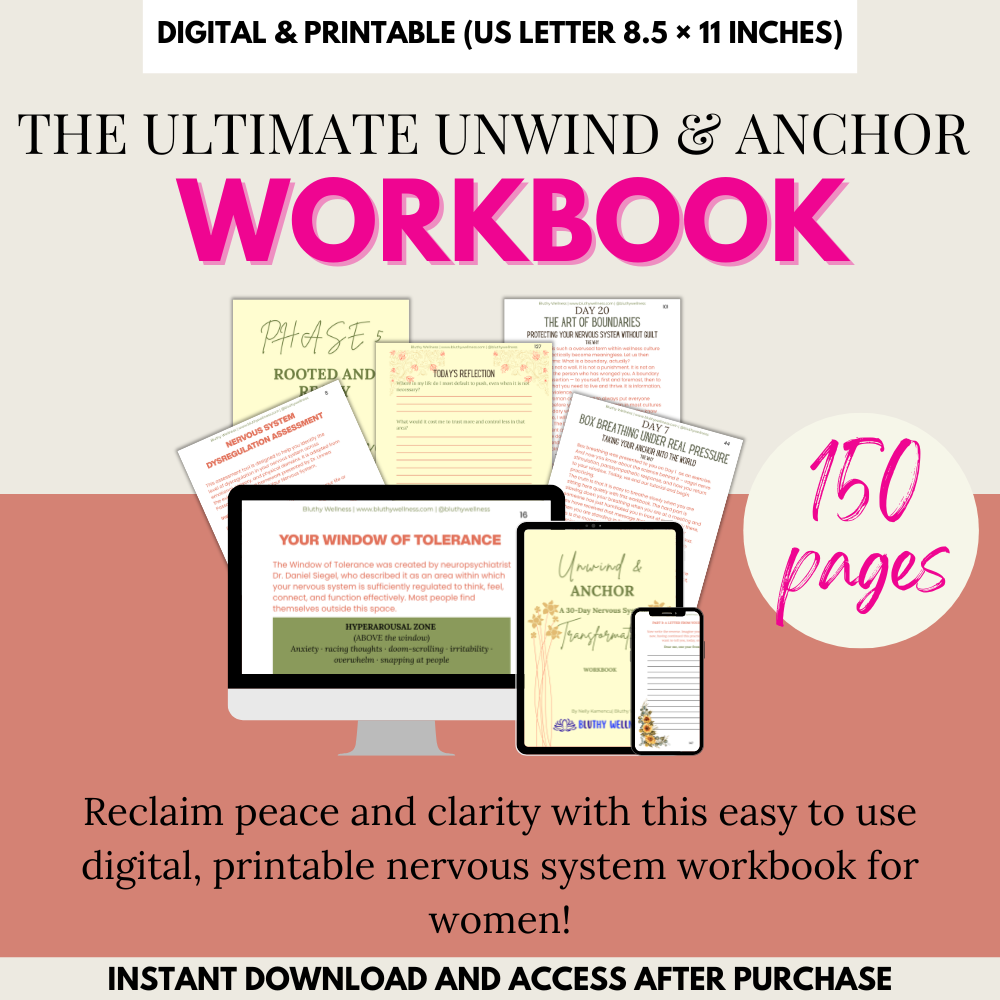
Original price was: KSh2,499.00.KSh1,999.00Current price is: KSh1,999.00.UNWIND AND ANCHOR WORKBOOK. A 30 DAY NERVOUS SYSTEM TRANSFORMATION. (DIGITAL AND PRINTABLE VERSIONS)
Original price was: KSh1,999.00.KSh1,499.00Current price is: KSh1,499.00.